
The world ferrous scrap market showed mixed dynamics in February 2026 after steady growth in January.
In particular, the growth trend continued in the EU and Chinese markets, albeit at a lower pace, while supplies decreased in the USA and Turkey. Despite the fluctuations, all markets are currently at a higher level than at the end of 2025.
In the Turkish market, prices for HMS 1&2 80:20 scrap for the period February 6 - March 6, 2026 decreased by 0.6% after growing by 1.9% in January - to $373.1/t CFR.
In February, the Turkish market was under moderate pressure - metallurgists restrained purchases due to weak demand for rebar, high inventories and financial constraints exacerbated by Ramadan.
The available alternative in the form of billet and pig iron imports limited the willingness of mills to pay more for scrap. At the same time, a deeper decline was restrained by raw material shortages in the EU and the US, adverse weather, snowfall on the US East Coast, rising freight rates and high purchase prices on domestic supplier markets.
At the end of the period, the key driver was the devaluation of the euro, which allowed Turkish mills to put pressure on European quotes. In early March, the war in the Middle East added additional uncertainty: freight and insurance increased, but real deals still recorded a decline in prices.
In the short term, the market is likely to remain under pressure, although the potential for a decline seems limited due to expensive freight and weak supply in exporting countries.
In the EU, scrap prices continued the trend of the beginning of the year and increased by 1-5%. In particular, in Germany, offers of E3 grade scrap in February increased by 5.3%, to €300/t ex-works, although they also reached €305/t. In Italy, prices reached €330/t ex-works, which is 1.5% more compared to January. The year-to-date growth is estimated at 11.1% for raw materials in Germany, and 5.6% in Italy.
In February, the European scrap market remained on the rise, mainly due to limited supply. In Germany and Austria, growth was supported by winter frosts, which complicated logistics, in particular river transport, as well as weaker imports from neighboring countries. In Italy, the drivers were low collection rates, especially for automotive grades, and steady demand for quality raw materials from mills. At the same time, further price increases were held back by weak demand for finished products, primarily rebar, high electricity and gas costs, as well as mills' reluctance to overpay for raw materials without support from steel sales.
In early March, the market entered a pause phase. Some Italian mills have already started to reduce purchase prices. Further stabilization is expected with local downward corrections, although the low level of scrap collection will continue to limit the depth of the decline.
On the US market (US East Coast), HMS 1/2 Scrap (80:20) lost 2.2% in price in February after growing by 2.3% in January. Currently, offers are $333/t FOB, which is still 1.1% higher than at the end of 2025.
The US scrap market remained mainly influenced by supply last month. The key factors were winter storms, frost, delays in yard operations, logistics and raw material collection, which initially supported domestic prices.
Mills were forced to increase purchase prices, especially for crushed and high-quality grades, to ensure supply flows. At the same time, the situation on the export side was weaker. Turkish buyers resisted higher prices, and rising freight and weak margins on finished steel limited the possibility of concluding new deals. By mid-month, the market had moved from an upward momentum to a conditional stabilization, as improving weather gradually reduced the risk of shortages and exports no longer provided an additional impetus.
In early March, the market entered a phase of relative stability. In the short term, stabilization or a moderate downward correction is likely if scrap collection and shipment execution improve, although expensive freight and an unstable external background will restrain a deeper decline.
In China, prices increased for both domestic and foreign scrap. In particular, domestic offers increased by 1.1% after 4.5% in January and are currently valued at $349.2/t. Foreign raw materials increased by 2.2% after 6.3% at the beginning of the year – to $347.5/t CFR.
During February, the Chinese scrap market grew moderately – after the holiday lull, supply recovered more slowly than demand from electric arc furnaces, which supported domestic prices. The driver was the gradual restart of smelting and expectations of increased purchases in March.
The import segment grew faster due to higher Japanese export prices and the currency factor, although real demand remained limited due to the superiority of domestic raw materials over imported ones. At the same time, the potential for further growth was restrained by the weak recovery in construction and sluggish final demand for steel. In the near future, the market is likely to remain relatively stable, but without a sharp rise.
Source: https://agronew>

Null-mod
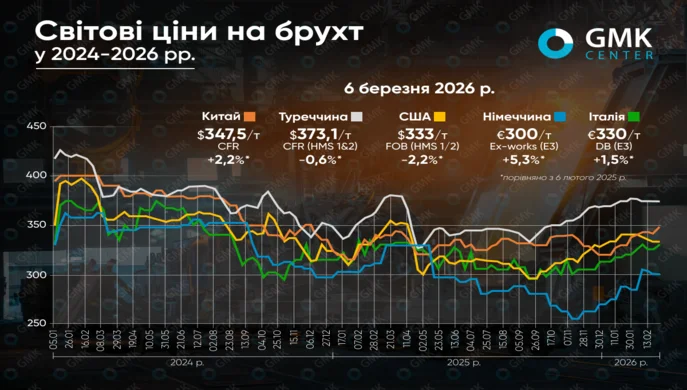
World scrap prices in February showed mixed dynamics

Services
Contacts
03150, Kyiv, str. K. Malevich 86P, Office 320
Phone+380 (44) 334 6141
+380 (96) 054 6080
+380 (63) 054 6080
+380 (50) 154 6080


